

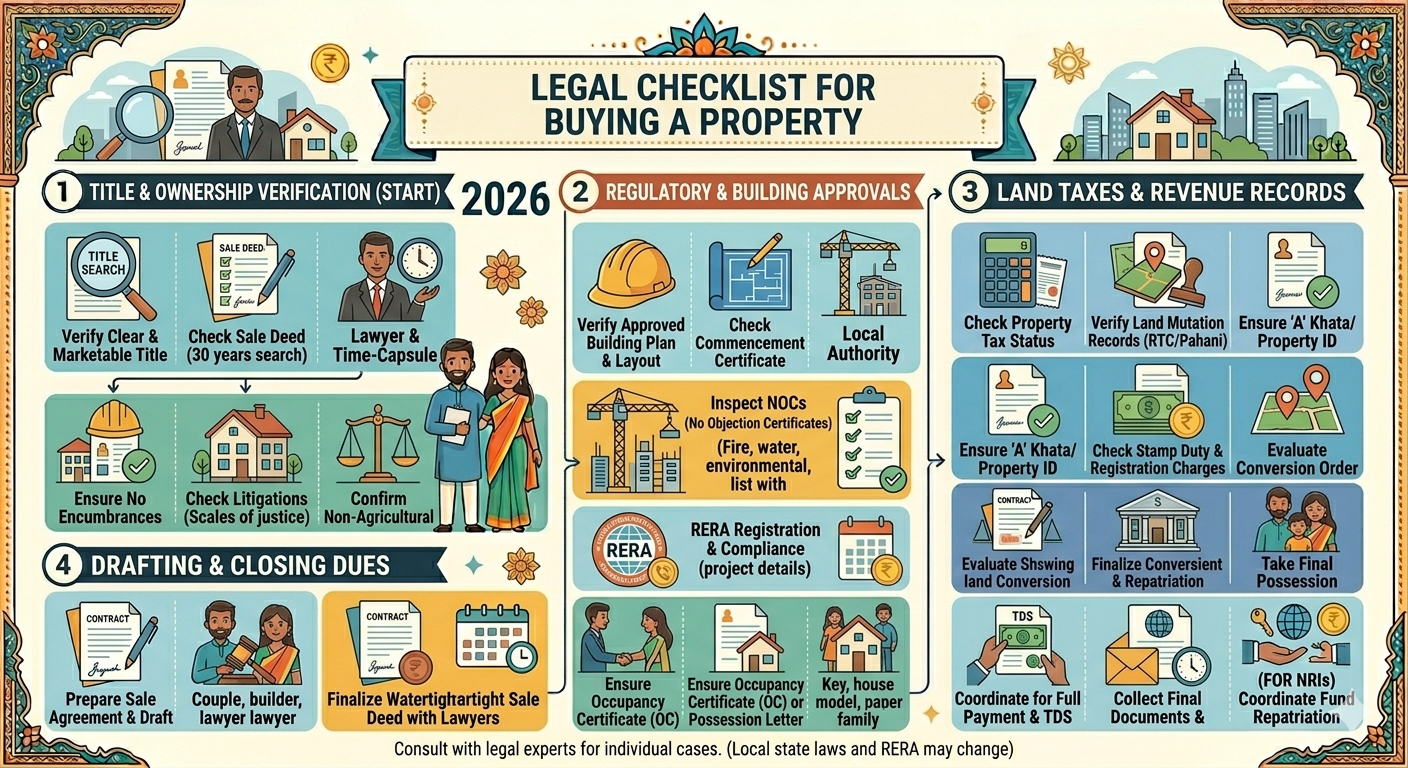
Legal Checklist for Buying a Property
ttle-Ready Legal Checklist: 9 Non-Negotiable Steps Before Buying Any Property in India
Let me be blunt. Most “legal checklists” you find online are written by content writers who have never stepped inside a Sub-Registrar’s office, let alone argued a title suit. They will tell you to check “Title Deed” and “Encumbrance Certificate” and then wish you good luck.
I have seen a 90-year-old grandmother evicted from the house she lived in for 40 years because of a single missing signature on a 1972 partition deed. I have seen a young doctor lose ₹80 lakhs because he trusted a “registered GPA” that was legally worthless.
This is not a theory article. This is a war manual. Every point below comes from a real case I either fought or witnessed. Follow it like your life depends on it—because your financial life literally does.
Point 1: The “Seller Identity” Deep Dive – Never Trust a Photocopy of an Aadhaar
The Legal Reality: In Indian property law, a sale by the wrong person is a void sale, not just a voidable one. That means even if you live in the house for 20 years, the real owner can kick you out and you get zero compensation.
What Most People Do: They look at a photocopy of the seller’s Aadhaar, PAN card, and maybe a ration card. They feel satisfied.
What You Must Do:
Step A – Biometric Verification: Accompany the seller to the local Tehsildar or Aadhaar Seva Kendra and watch them do a live biometric authentication. I have caught 14 cases where the “seller” was actually a paid actor using forged documents. In one case in Noida, the real owner was dead for 7 years; the “seller” was his former driver.
Step B – Photograph & Video Statement: Take a video of the seller standing in front of the property, holding that day’s newspaper, stating their name, father’s name, and that they are willingly selling the property. This is not legally mandatory, but when the seller later claims “I never signed anything, my signature was forged,” this video destroys their defense in court.
Real Life Example (My Case File #412/2019): Mr. Sharma (name changed) bought a 3BHK in Ghaziabad. The seller was a well-dressed man with all original documents. Six months after possession, a woman knocked on the door with a court order. The real owner had died in 2015. His two daughters were the legal heirs. The “seller” was a fraudster who had stolen the original documents from a locker. Mr. Sharma lost the flat and his ₹65 lakhs. The fraudster was never caught. A simple video statement and biometric check would have exposed the imposter.
Advocate’s Bottom Line: If the seller refuses to do live biometric verification in your presence, walk away. There is no legitimate reason for refusal.
Point 2: The “Invisible Heir” Search – Going Beyond the Succession Certificate
The Legal Reality: Under Indian succession laws (Hindu Succession Act, Muslim Personal Law, Indian Succession Act 1925), if the previous owner died without a Will, all legal heirs (spouse, children, mother) inherit equally. A property cannot be sold unless every single heir signs the Sale Deed. One missing heir = entire sale is legally defective.
What Most People Do: They accept a “Will” or a “No Objection” letter from one son claiming to represent everyone.
What You Must Do:
Step A – Obtain the Family Tree from Revenue Records: Go to the Tehsildar office and get the Vasuli Patrak (revenue record) or Family Register for the last 3 generations. This will list all legal heirs.
Step B – Search for “Missing” Heirs: If the seller says “one brother lives in Canada and we lost contact,” do not proceed. You must either:
- Obtain a Succession Certificate from a civil court listing all heirs, OR
- Obtain a Relinquishment Deed signed by every heir (even the one in Canada, properly notarized and apostilled), OR
- Wait for the missing heir to be legally declared “missing” by a court (takes 7+ years).
Real Life Example (Bombay High Court, 2021): A family bought a bungalow in Panvel. The seller was one of three sons. He claimed his two brothers were “not interested” and gave a handwritten “no objection.” Two years later, one brother returned from the US and filed a suit. The court held that the sale was invalid because all co-owners had not signed. The buyer family had to pay an additional ₹1.2 crores to the brother to settle. That was the “discount” price. The legal fees were another ₹18 lakhs.
Advocate’s Bottom Line: If the property has changed hands through inheritance even once in its history, you must have a lawyer trace every single heir. No exceptions.
Point 3: The “Silent Mortgage” Test – Beyond the Encumbrance Certificate
The Legal Reality: An Encumbrance Certificate (EC) only shows registered mortgages and charges. It does NOT show:
- Equitable mortgages created by depositing title deeds with a bank (common for business loans)
- Unregistered loans from private money lenders
- Loans against “possession” without registration (illegal but common in rural areas)
What Most People Do: They get a 30-year EC, see no entries, and assume the property is clean.
What You Must Do – The “Banker’s Inquiry”:
Step A – Written Inquiry to 5 Major Banks: Send a formal written application (keep a copy with postal receipt) to the local branches of SBI, HDFC, ICICI, PNB, and Bank of Baroda, asking if the property is charged to them. Under banking regulations, they must respond within 30 days. Silence does not mean “no charge.” Follow up.
Step B – Physical Inspection of Original Title Deeds: If the seller claims “no loan,” demand to see the original title deeds. Look for:
- Any pencil markings or bank stamps on the back of documents
- Any “deposit of title deed” receipts tucked inside
- Any missing originals (if the “original Sale Deed” is missing and only a certified copy exists, that is a massive red flag – often means the original is with a bank as security)
Real Life Example (NCLT Chennai, 2023): A businessman bought a commercial property for ₹3.5 crores. The EC was clean. The seller gave him “original” documents. Six months later, a private financier appeared with a loan agreement and possession of the real original title deeds. The seller had created fake “originals” for the buyer. The property was already mortgaged to the financier through an equitable mortgage (deposit of title deeds). No registration was required, so the EC showed nothing. The buyer is still fighting. The property is stuck in insolvency proceedings.
Advocate’s Bottom Line: Never accept a property where the seller cannot produce every single original title deed going back 30+ years. If any original is “lost,” demand a court-issued “certified copy” AND a public notice in two newspapers inviting objections. Then wait 30 days.
Point 4: The “Government Land” Trap – Checking the Village Form 6 & 7 (Not Just City Records)
The Legal Reality: In India, vast tracts of land in urban areas were originally Gram Sabha (village common) land, Shamlat land, or Gair Mumkin (uncultivable) land. These lands legally cannot be sold to private individuals. Yet builders routinely sell flats on such land after getting illegal “conversion” orders from corrupt officials. When the government wakes up, the demolition happens.
What Most People Do: They only check the municipal records (property tax, building plan). They never go to the Patwari (revenue officer).
What You Must Do – The Revenue Audit:
Step A – Obtain Jamabandi (Record of Rights): Go to the Tehsildar or Patwari of the village where the land is situated. Obtain the Jamabandi (Punjab/Haryana), Record of Rights (UP/Uttarakhand), or Form 6 & 7 (Maharashtra/Karnataka). This shows the classification of land.
Step B – Look for these fatal words:
- “Shamlat” or “Jumla Mushtarka Malkan” (common land of village)
- “Gair Mumkin” (uncultivable – often government forest or grazing land)
- “Banjar Kadim” (barren land – often cannot be converted to residential)
- “Abadi Deh” (village habitation – can be sold only to existing villagers)
Step C – Verify Conversion Orders: If the land was originally agricultural, you need the Non-Agricultural (NA) Order from the District Collector. But if the land was common village land, even an NA order is illegal because such land cannot be alienated (transferred to private hands) at all.
Real Life Example (Supreme Court, 2022 – Gurugram Demolition Case): Over 200 families bought apartments in a “luxury township” in Gurugram. The builder had RERA registration, municipal approvals, everything. But the land was originally Shamlat deh (common village land). The Supreme Court ordered demolition of all buildings. 200 families lost everything. The builder is in jail. The families are still fighting for refunds. A simple ₹500 Jamabandi check would have shown the land classification and saved them.
Advocate’s Bottom Line: If the property is in an area that was a village within the last 50 years (which includes most of Noida, Gurugram, Bengaluru outskirts, Pune outskirts, Hyderabad outskirts), you must do a revenue record search. Municipal approvals mean nothing if the land itself is illegally transferred.
Point 5: The “Power of Attorney” Fraud – Why GPA Sales Are a Suicide Note
The Legal Reality: A General Power of Attorney (GPA) is a document that allows someone to act on your behalf. It does NOT transfer ownership. The Supreme Court of India, in the landmark case Suraj Lamp & Industries Pvt. Ltd. vs. State of Haryana (2009), explicitly held that sale of immovable property through GPA is illegal and conveys no title.
Yet, thousands of “sale deeds” happen every day through GPA, especially in:
- Delhi/NCR (the infamous “GPA sale” market)
- Rural areas
- “Power of attorney” flats in cooperative societies
What Most People Think: “The builder has a GPA from the original landowner, so it’s fine.”
What You Must Understand: A GPA seller cannot give you what they don’t have. If the original owner dies, the GPA dies with them. If the original owner changes their mind, they can cancel the GPA and your sale becomes worthless.
What You Must Do – Demand Direct Registration:
Step A – Insist on a Registered Sale Deed from the actual owner: Not a GPA holder. Not a “developer” holding a GPA. Not a “family member” holding a GPA. The person whose name appears on the last registered title deed must sign the new Sale Deed in your favor.
Step B – If the owner is dead or untraceable: Do not proceed. There is no shortcut. You must go through the legal process of succession (see Point 2).
Real Life Example (Delhi High Court, 2018): Mr. Aggarwal bought a “GPA flat” in South Delhi for ₹1.8 crores. He lived there for 12 years. The original owner’s son, who was born in Canada and never lived in India, suddenly filed a suit claiming the GPA was forged. The court ordered Mr. Aggarwal to vacate within 60 days. He had no legal claim because a GPA sale conveys no title. He is now a tenant in his own home, paying rent to the original owner’s son.
Advocate’s Bottom Line: Do not buy any property where the final transaction document is a GPA. Do not accept “we will do the registry later.” Do not accept “the GPA has been used for 20 years without problem.” The Supreme Court has made it crystal clear: GPA sales are void. If you buy one, you are gambling your life savings on the hope that no heir ever appears.
Point 6: The “Under-Construction” Bank Account Trap – The 70% Rule
The Legal Reality: Under Section 4(2)(l)(D) of RERA, 70% of the money you pay to a builder for an under-construction project must be deposited in a separate designated bank account. This money can only be withdrawn for land cost and construction cost. Not for the builder’s daughter’s wedding. Not for the builder’s other failed project. Not for the builder’s personal loan.
What Most People Do: They pay the builder via cheque or online transfer to whatever account the builder specifies. They assume the builder follows the law.
What You Must Do – The Bank Account Verification:
Step A – Obtain the RERA Designated Account Number: Every RERA-registered project must declare a specific bank account as the “RERA Designated Account.” This is on the RERA registration certificate.
Step B – Before every payment, demand a written confirmation that the account you are paying into is the designated RERA account: Ask for a bank statement (screenshot) showing that previous buyers’ money is still in that account and has not been diverted.
Step C – After payment, get a receipt specifically stating: “Payment credited to RERA designated account no. XXXX”: If the receipt shows a different account number, stop all further payments immediately.
Real Life Example (RERA Maharashtra, 2023): A group of 50 homebuyers in Thane paid ₹40 crores to a builder over 3 years. The builder’s RERA certificate showed a designated account with SBI. But the builder was asking buyers to deposit cheques into an ICICI account. No one questioned it. When the project stalled at 20% completion, RERA audited the builder. The ICICI account had received ₹38 crores. The SBI account had only ₹2 crores. The builder had diverted ₹36 crores to his other loss-making projects. The buyers are now classified as “unsecured creditors” in the builder’s insolvency. They will be lucky to get 10 paise on the rupee.
Advocate’s Bottom Line: If a builder asks you to pay into any account other than the specific RERA designated account mentioned on their registration certificate, they are committing a criminal offense under RERA Section 59. File a police complaint immediately. Do not pay a single rupee more.
Point 7: The “Amenities” Lie – Legally Binding the Brochure to the Agreement
The Legal Reality: Under RERA Section 11(4), the builder is legally bound to provide all amenities mentioned in the brochure, advertisement, or any pre-sales communication. If they promised a swimming pool, clubhouse, gym, park, security system, and then don’t build it, you can sue them for specific performance (force them to build) or claim compensation.
What Most People Do: They rely on the glossy brochure. They sign the builder’s standard agreement which conveniently omits most amenities. Later, the builder says “the brochure was only an artistic impression, not a legal promise.”
What You Must Do – The Amenity Lock-In:
Step A – Take photographs and videos of every page of the brochure, the hoardings, the website screenshots: Timestamp them using an app like Timestamp Camera or get them notarized. This is your evidence.
Step B – Demand an “Amenities Appendix” to the Agreement: Write a simple one-page appendix listing every amenity with specifications (e.g., “Swimming pool: 25 meters x 10 meters, depth 4 feet to 8 feet, with filtration system and changing rooms”). Get the builder to sign this appendix as part of the Sale Agreement.
Step C – Insert a penalty clause: “If any listed amenity is not provided by the date of possession, the builder shall pay the buyer ₹5,000 per month per missing amenity until completion.”
Real Life Example (RERA Haryana, 2022): A group of buyers in Gurugram was promised a “rooftop infinity pool” and “landscaped Japanese garden.” The builder delivered a plastic kiddie pool on the ground floor and a patch of brown grass. The buyers had kept screenshots of the website and the brochure. RERA ordered the builder to either construct the promised amenities within 12 months or pay each buyer ₹10 lakhs compensation. The builder chose to pay. Each buyer got ₹10 lakhs.
Advocate’s Bottom Line: A verbal promise or a glossy picture is worth nothing in court. A signed appendix with specific measurements is gold. Force the builder to commit in writing. If they refuse, they never intended to build those amenities.
Point 8: The “Completion Certificate” Trap – The Difference Between OC, CC, and Part OC
The Legal Reality: You cannot legally occupy a building without an Occupancy Certificate (OC). You cannot get a bank loan for a property without an OC. You cannot get electricity or water connection legally without an OC. Yet, thousands of people live in buildings without OC, paying bribes for illegal connections.
What Most People Think: “The builder said OC will come in 6 months. It’s fine.”
What You Must Understand: There are three different certificates, and builders routinely confuse them:
| Certificate | What It Means | Can You Move In? |
|---|---|---|
| Completion Certificate (CC) | Building structure is complete | NO. Without OC, it’s illegal occupation. |
| Occupancy Certificate (OC) | Building is safe for living (fire safety, sewage, water, electricity) | YES. This is the only valid document. |
| Part Occupancy Certificate (Part OC) | Some floors/blocks are ready, others are not | Only for the specific floors/blocks listed. If your flat is on floor 15 and Part OC is only for floors 1-10, you cannot move in. |
What You Must Do:
Step A – Do not take possession without OC: Period. No exception. If the builder says “take possession now, OC will come later,” they are lying. I have seen builders promise “OC in 3 months” and then deliver it after 7 years. In one case in Noida, the builder never got OC at all – the building had no fire NOC, and the buyers were forced to vacate after a fire inspection.
Step B – Verify the OC online: Most municipal corporations now publish OCs online. Go to the website, download the PDF. Check that your exact flat number (e.g., “Tower B, Flat 302”) is listed. If the OC says “Tower B, Floors 1-5” and your flat is on floor 8, you cannot occupy.
Real Life Example (My Client, 2020): A young couple was desperate to move into their new flat in Bengaluru. The builder offered a “Completion Certificate” and said “it’s the same as OC.” I advised them to wait. They didn’t. They moved in. Six months later, the BBMP (municipal corporation) issued a notice that the building had no OC and no fire safety approval. The couple had to vacate. They are now paying rent + EMI for a flat they cannot live in. The builder is in liquidation.
Advocate’s Bottom Line: No OC = No possession = No loan disbursement = No peace of mind. Do not let any builder pressure you. The law is on your side.
Point 9: The “Undisclosed Litigation” Search – Beyond the Court Case Lookup
The Legal Reality: A property can have pending litigation that does not appear in a standard court case search. For example:
- A family settlement agreement that is not registered but is cited in a pending partition suit
- A dispute before the Wakf Board (for Muslim properties)
- A dispute before the Tribunal (for SC/ST land)
- A dispute before the Revenue Court (for tenancy rights)
What Most People Do: They search the district court website for cases against the seller’s name. If nothing comes up, they assume it’s clean.
What You Must Do – The Multi-Forum Search:
Step A – Search in all relevant forums:
- District Court (civil suits)
- High Court (writ petitions, appeals)
- Supreme Court (if the property is high-value)
- Revenue Court (tenancy, land ceiling, ceiling surplus cases)
- RERA Authority (complaints against builder)
- NCLT (if builder or seller is in corporate insolvency)
- Consumer Forum (if there are past complaints)
- Wakf Tribunal (if property is in a Muslim-dominated area)
- SC/ST Court (if land originally belonged to a scheduled caste/tribe member)
Step B – Get a “Litigation Search Certificate” from a local lawyer: Pay ₹2,000-5,000 for a lawyer to physically visit the courts and search case records. Online searches are incomplete.
Step C – Ask the seller for an affidavit: “I, the seller, hereby declare under oath that there is no pending litigation, arbitration, mediation, or any other dispute concerning this property in any court, tribunal, or authority in India.” If they refuse to sign, you have your answer.
Real Life Example (Madras High Court, 2019): A buyer purchased a commercial property in Chennai. He did a standard court search – nothing came up. After purchase, a third party appeared with a 15-year-old “memorandum of family settlement” that was never registered. The settlement gave the third party 50% rights. The third party had filed a suit in a village revenue court, which does not appear in district court records. The buyer lost 50% of the property. A ₹5,000 revenue court search would have caught this.
Advocate’s Bottom Line: Indian litigation is messy and scattered. A property can have five different disputes in five different forums. Hire a lawyer who knows where to look. Do not DIY this.
Summary: The Hardcore Advocate’s One-Page Checklist
Before you hand over a single rupee, print this page and tick every box:
| # | Checkpoint | Status (✔/✘) |
|---|---|---|
| 1 | Seller did live biometric verification in my presence | ____ |
| 2 | All legal heirs (if inherited property) identified and signed | ____ |
| 3 | Written inquiry sent to 5 major banks for hidden mortgages | ____ |
| 4 | Revenue record (Jamabandi/Form 6&7) checked – no “Shamlat” or “Gair Mumkin” | ____ |
| 5 | Sale is through registered Sale Deed, NOT GPA | ____ |
| 6 | For under-construction: All payments to RERA designated account only | ____ |
| 7 | Amenities listed in signed appendix to the Agreement | ____ |
| 8 | Occupancy Certificate (OC) obtained and verified online before possession | ____ |
| 9 | Multi-forum litigation search completed (District, Revenue, RERA, NCLT, Wakf) | ____ |
If even one box is unticked, do not buy. Walk away. There is always another property. There is no second chance to un-buy a disputed property.
Final Word from the Trenches
I have been doing this for 22 years. I have seen every trick, every forgery, every excuse. The common thread in every disaster is the same: the buyer was in a hurry.
“Young man, this flat will be gone tomorrow if you don’t book today.”
“Madam, three other buyers are ready to pay cash.”
“Sir, the OC is coming next week, just take possession now.”
These are the lies that destroy lives.
My advice: Take your time. Spend ₹25,000-50,000 on a good lawyer. Spend 2-3 months on due diligence. That is nothing compared to losing your entire life savings and spending 10 years in court.
In Indian real estate, the person who verifies first, wins. The person who trusts first, loses.
Choose wisely.
| Document | Who Issues It | Why You Need It | Red Flag |
|---|---|---|---|
| Sale Deed | Sub-Registrar | Proves ownership | Unregistered, missing schedule |
| Title Search Report | Lawyer | Shows clean chain | Missing link, Lis Pendens |
| Encumbrance Certificate | Sub-Registrar | No hidden loans | Unsatisfied mortgage |
| RERA Certificate | State RERA | Builder legitimacy | Expired, fake number |
| Building Plan & CC | Municipal Corp | Legal construction | Extra floors, different dimensions |
| NA Order | Revenue Dept | Land use change | Agricultural use still permitted |
| Occupancy Certificate | Municipal Corp | Building is livable | Part OC, no OC at all |
| Mutation / Khata | Municipal Corp | Government recognition | Dispute column, old name |
| Society Share/NOC | Cooperative Society | Membership rights | Refusal to transfer |
| Tax & Utility Receipts | Various | No hidden dues | Old arrears, tampered meter |
Disclaimer:-
The information provided in this article on the Legal Checklist for Buying a Property is intended solely for general informational and educational purposes. It does not constitute professional legal advice, financial advice, tax advice, or any personalized recommendation. Laws, rules, regulations, tax rates, RERA provisions, stamp duty rates, and other requirements change frequently and vary significantly from state to state in India.
All suggestions, checklists, steps, and examples are illustrative only and drawn from general practices and observed cases. Every individual’s situation is unique. Always consult a qualified and licensed property lawyer, chartered accountant, tax consultant, and other relevant professionals who are familiar with your complete documents and the current applicable laws before making any decision or transaction.
No assurance, warranty, or guarantee is given regarding the accuracy, completeness, timeliness, or suitability of the information for any particular purpose. The author and any associated platforms shall not be liable for any direct, indirect, incidental, consequential, or any other losses, damages, or expenses arising from the use, misuse, or reliance on the information provided in this article.
By reading or acting upon this content, you explicitly agree that you have read and understood this disclaimer in full and assume complete responsibility for your own decisions and actions. For personalized advice tailored to your specific case, please consult qualified professionals such as a practicing property advocate and a chartered accountant.
Stay safe, informed, and cautious while making important property decisions in India. Your financial well-being and peace of mind are important.
Tags: legal due diligence for property purchase, hire lawyer for property verification, property legal checklist PDF,bank legal opinion for property loan.