

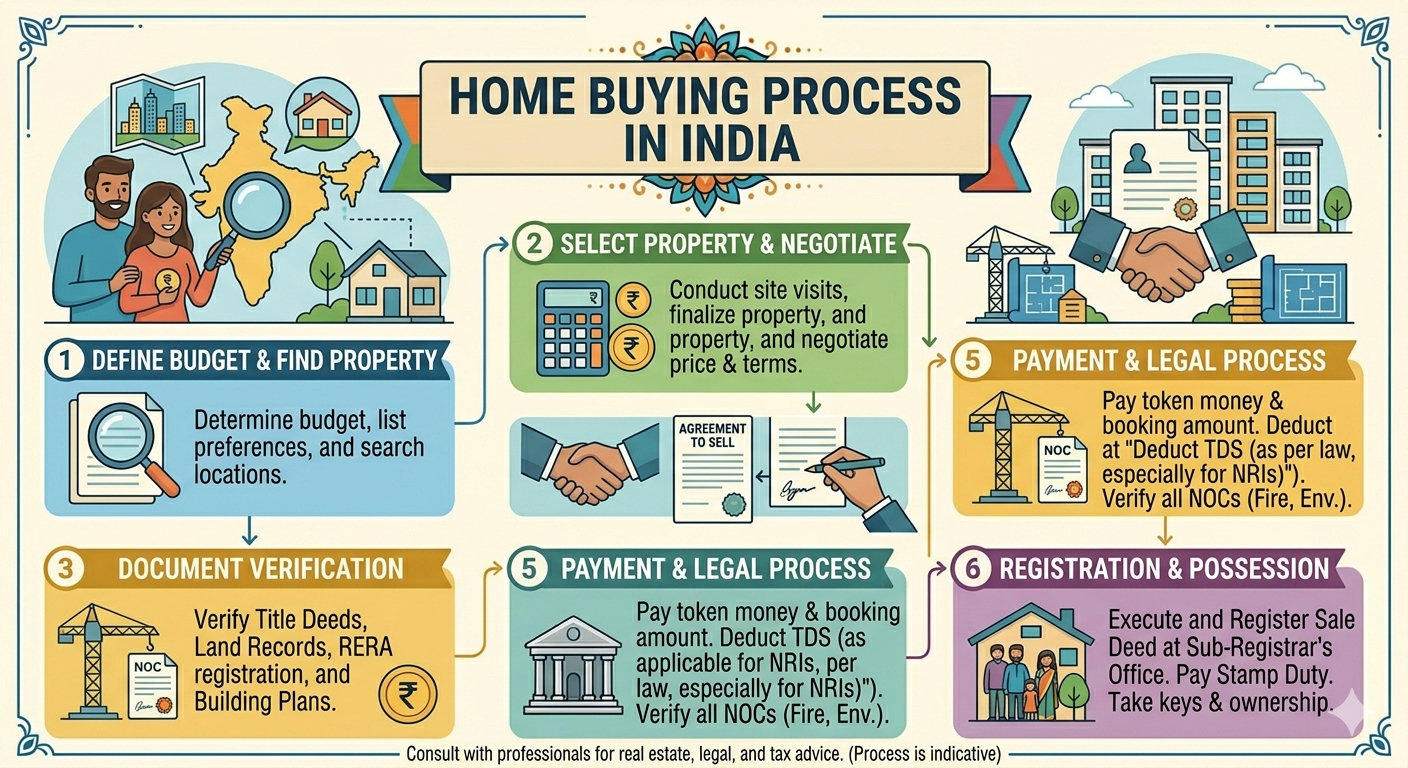
Home Buying Process in India: Your Complete Step-by-Step Legal Checklist for 2026
Home Buying Process in India: Your Complete Step-by-Step Legal Checklist for 2026
Hey friend, buying a home in India is a dream for millions, but it can quickly turn into a nightmare if you don’t follow the right Home Buying Process in India. After working as a seasoned property advocate for more than 18 years and handling thousands of home purchases across Delhi-NCR, Mumbai, Bangalore, Hyderabad, Chennai, and Pune, I have seen families achieve lifelong security when they follow the proper Home Buying Process in India. At the same time, I have witnessed heartbreaking cases where people lost lakhs — sometimes their entire savings — simply because they skipped critical steps.
This article gives you a clear, practical, and complete Home Buying Process in India that works as your personal legal checklist. It covers every important factor in detail — budget, loan eligibility and payment terms, location, property type and details, and all essential legal documents. Every point is explained with real-life examples from cases I have personally handled in 2026 so you can avoid the same mistakes and buy your dream home safely.
Why Following the Correct Home Buying Process in India Is Crucial in 2026
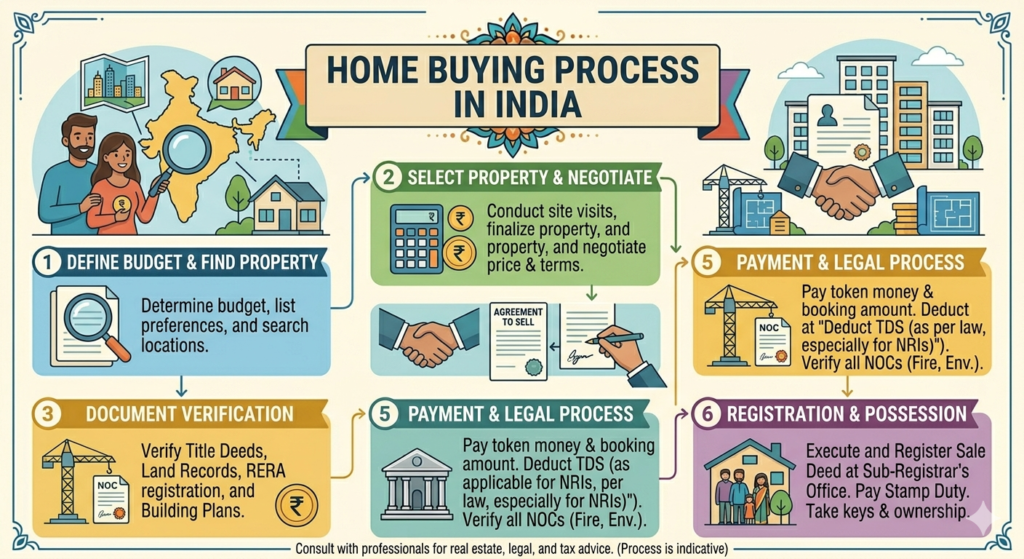
The real estate market is more regulated today with RERA and digital land records, yet risks like unclear titles, hidden dues, delayed projects, and unfair agreements still exist. Rushing through the Home Buying Process in India without a proper checklist often leads to years of court cases or financial loss. This Home Buying Process in India serves as your safety shield — it ensures you check budget, loan eligibility, payment terms, location, property type, and legal documents before emotions take over.
Step 1: Budget Planning – The Foundation of the Home Buying Process in India
The first and most important step in the Home Buying Process in India is preparing a realistic and complete budget. Never focus only on the advertised price. You must add stamp duty (usually 5-8% depending on the state), registration charges (1-2%), GST on under-construction properties (5% or 12%), lawyer fees, interior work, maintenance deposits, and a 6-12 month buffer for any delays or extra EMI.
In early 2026, a young couple in Gurgaon followed most parts of the Home Buying Process in India but skipped a full budget calculation. They booked a 3BHK flat for ₹1.85 crore with 10% token money. When the final cost sheet arrived, stamp duty and registration added another ₹17.5 lakhs. They could not arrange the extra funds in time and lost the booking amount. Had they created a detailed Excel sheet at the beginning of the Home Buying Process in India, they would have negotiated better or chosen a more suitable project.
Step 2: Loan Eligibility and Payment Terms – A Critical Check in the Home Buying Process in India
Before you shortlist any property, get your home loan pre-approved from a bank or housing finance company. Banks carefully check your income documents, existing loans, CIBIL score (750+ is safest), age, and job stability. Clearly understand the EMI amount, interest rate, pre-payment charges, and the complete payment schedule from the seller or builder.
I handled a painful case in Hyderabad where a client ignored this step in the Home Buying Process in India. He paid 20% down payment on a ready-to-move villa, but his loan application was rejected because of two small unpaid personal loans. The builder refused to refund the booking amount citing the agreement. It took us six months and consumer court to recover most of the money. Always treat loan pre-approval and written payment terms as non-negotiable in the Home Buying Process in India.
Step 3: Location Evaluation – A Make-or-Break Factor in the Home Buying Process in India
Location decides both your daily comfort and the future value of your home. Check connectivity to your office, schools, hospitals, and markets. Verify upcoming infrastructure like metro lines, highways, or new commercial projects. Also inspect for flooding history, water supply quality, power backup, and neighbourhood safety. Visit the site at least three times — during day, evening, and weekends.
A family in Mumbai rushed the location check while following the Home Buying Process in India. They bought a sea-facing flat in Navi Mumbai because the view looked stunning. Later they discovered chronic water-logging during monsoons and a delayed metro project. Their resale value dropped sharply. Multiple site visits and talks with local residents as part of the Home Buying Process in India would have saved them from regret.
Step 4: Property Type and Detailed Inspection – Practical Steps in the Home Buying Process in India
Decide whether you want a ready-to-move flat, under-construction property, independent house, or villa. For ready properties, hire a qualified civil engineer for a structural inspection. For new projects, verify actual construction progress against the promised timeline and check material quality.
In Bangalore, one of my clients bought an under-construction 4BHK without proper inspection as advised in the Home Buying Process in India. At possession, he found poor ventilation, substandard electrical wiring, and several promised amenities missing. Fixing everything cost him an extra ₹12 lakhs. A professional engineer’s report would have caught these issues early in the Home Buying Process in India.
Step 5: Legal Documents Verification – The Heart of the Home Buying Process in India
This is the most crucial part of the entire Home Buying Process in India. Demand and thoroughly verify the following documents:
- Full chain of title documents covering at least the last 30 years
- Latest Encumbrance Certificate (EC) from the sub-registrar’s office showing no loans, liens, or disputes
- RERA registration number and project details (for under-construction flats)
- Approved building plans, commencement certificate, and occupancy certificate
- Latest property tax receipts and utility bill clearance proofs
- Seller’s or builder’s PAN, Aadhaar, and clear ownership proof
- No-objection certificates (NOC) from bank or society if required
A doctor in Pune suffered a loss of ₹48 lakhs because he skipped detailed legal document verification in the Home Buying Process in India. The land he purchased was still recorded as agricultural in revenue records and could not be used for residential construction. Proper title search and legal verification by an experienced advocate would have prevented this loss.
Final Steps in the Home Buying Process in India
Once all checks are complete, proceed to draft the Agreement to Sell, get it reviewed by your lawyer, and register the final sale deed. Ensure mutation of the property in your name and immediate transfer of utility connections. Never release full payment until the sale deed is registered and legal possession is handed over.
Conclusion
The Home Buying Process in India is straightforward when you follow a proper legal checklist. By carefully covering budget, loan eligibility, payment terms, location, property type and details, and all legal documents, you protect yourself from common pitfalls and future disputes. Use this Home Buying Process in India as your personal guide, involve a qualified property advocate early, and you will successfully own your dream home with complete peace of mind.
Tags:
home buying process in India 2026, complete checklist for buying home in India, legal steps for buying house in India, documents required for home purchase India, home loan eligibility and approval process, budget planning for home buying in India, RERA verification before buying property, title verification checklist for home buyers, stamp duty and registration charges for home 2026,
step by step guide to buy home in India, encumbrance certificate importance in home buying, occupancy certificate for new homes, avoiding common mistakes in home buying process, engineer inspection for ready to move homes, power of attorney for property purchase in India.
Disclaimer
The information provided in this article on the Home Buying Process in India is intended solely for general informational and educational purposes. It does not constitute professional legal advice, financial advice, tax advice, or any personalized recommendation. Laws, rules, regulations, tax rates, RERA provisions, stamp duty rates, and other requirements change frequently and vary significantly from state to state in India.
All suggestions, checklists, steps, and examples are illustrative only and drawn from general practices and observed cases. Every individual’s situation is unique. Always consult a qualified and licensed property lawyer, chartered accountant, tax consultant, and other relevant professionals who are familiar with your complete documents and the current applicable laws before making any decision or transaction.
No assurance, warranty, or guarantee is given regarding the accuracy, completeness, timeliness, or suitability of the information for any particular purpose. The author and any associated platforms shall not be liable for any direct, indirect, incidental, consequential, or any other losses, damages, or expenses arising from the use, misuse, or reliance on the information provided in this article.
By reading or acting upon this content, you explicitly agree that you have read and understood this disclaimer in full and assume complete responsibility for your own decisions and actions. For personalized advice tailored to your specific case, please consult qualified professionals such as a practicing property advocate and a chartered accountant.
Stay safe, informed, and cautious while making important property decisions in India. Your financial well-being and peace of mind are important.